




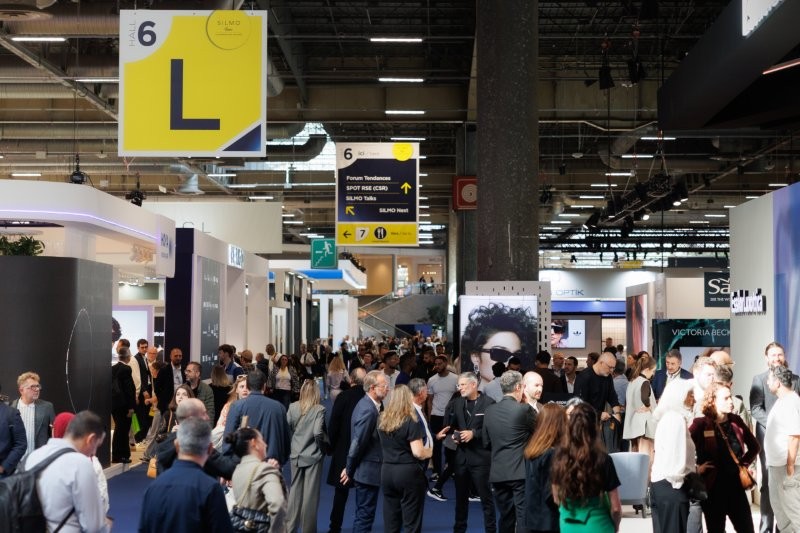
This year, artificial intelligence (AI) was the central theme of Silmo Next, with its Futurology space and new Village Tech area inviting visitors to experience the future of optics via connected eyewear, automated examinations, virtual reality, intelligent store-management systems and more.
Silmo Next, an initiative dedicated to exploring future trends and innovations in the industry, provided insights on design, technology and retail trends, all showcased at the Silmo event.
Whether generative, contextual or descriptive, AI is already transforming the optical sector, according to Sébastien Brusset, Silmo Next committee member and CEO of eyewear design Jaw Studio in Lyon. “Today, the market is still quite traditional. Tomorrow, they say a pair of glasses will replace your phone. This will change the role of the optician and transform the market,” he said.

Sébastien Brusset
Brusset told the audience he expects the upheaval to bring some cannibalisation (possibly 20–30% of current eyewear players) but he also highlighted that the change brings opportunity, since the optician is an established point of entry and an existing sales channel. “Take health apps’ extended services as an example. Glasses are very precisely measuring health data, which puts the optician at the very heart of this development,” he said.
To avoid an Uberisation of the eyewear market – tech giants going directly to the customer and cutting out the middleman – practice owners need to urgently recognise this paradigm shift and overhaul the training of practice staff to develop different skills and services, Brusset said. “Questions to consider today are: how can I create value as an optician in the face of tech giants? How can I integrate these new technologies into my store? How should I train my team on smart glasses and AI?”
Hyperpersonalise your life
Mikael Eriksson, CEO of Swedish wearable tech company and Silmo d’Or 2022 winner Skugga Technology, agreed the shift to smart, digital eyewear is already happening. He compared it to the move from mobile phones to smartphones, when Apple crushed Nokia as the bestselling mobile phone provider in just three years (Apple introduced its first smartphone in 2007). Eriksson predicts smart eyewear will go from being a niche product to mass market in 2027/2028.
Smart eyewear is the best way to collect data but the reason it isn’t already engulfing the industry is because the ‘killer app’ technology allowing hyperpersonalisation has been missing, but it’s happening now with AI, Eriksson said. “Five years ago, nobody was interested, but then AI happened (bringing) the capability to process huge amounts of data. We are now an AI-first company and it has allowed us to combine things we didn’t even know existed, offering the wearer personalised AI.”
The buying experience is also changing with smart eyewear, moving out of the shop and into the home. As with a smartphone, you unlock all the apps and connect to the world once you are back home with the product, said Eriksson.
Health drivers
UK-based plastic and reconstructive surgeon and founder of wearable tech firm Emteq Dr Charles Nduka told us smartglasses are the next evolution of health and will help reduce negative health outcomes. Emteq’s open platform, OCOsense, originated from research on facial paralysis and its wearable tech uses sensors to measure facial muscle activity. “Most other products focus on the outside world but our first product (nearing launch at the time of writing) measures eating behaviour. It is known that if you eat quickly, you gain weight and instant feedback gives you a chance to navigate your life and make better choices,” said Dr Nduka. “In the future, glasses will let us see ourselves differently, see more, do more and go further.”

Dr Charles Nduka
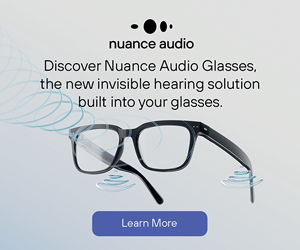
Also creating a buzz was EssilorLuxottica’s Nuance Audio, an all-in-one hearing and vision solution and Silmo d’Or winner in the smart eyewear category. Designed for people with mild to moderate hearing loss, Nuance fits perfectly with eyewear and the technology will soon be shared with the group’s other brands, including Oakley, said the company.

EssilorLuxottica brand manager Nieves Rojas
Another hugely popular interactive demo was Snapchat, showcasing its now fifth-generation augmented reality (AR) glasses, called Spectacles, due for general release in 2026. The demo was so popular I didn’t even get to try them! Spectacles, quite chunky looking, are designed to let the wearer capture and share the world from their point of view and, increasingly, to interact with digital content in the real world through gaming, shared AR experiences and location-based AR, such as navigation or guidance through a city or museum.

AR layers over reality with Snapchat's Spectacles
Speaking to other Silmo delegates, there was some scepticism about how wearable the smart tech will be in terms of allowing a comfortable fit and style, suggesting the industry is still some distance away from being able to seamlessly integrate smart tech in everyday frames. However, Dr Nduka and others were firm that it’s only a matter of time until there’s a “critical investment mass” that will transform the technology to be smaller and lighter still.
Audience concerns were also raised about privacy; for example, would wearers be able to enter a sensitive commercial space or a public space, like a hospital, without having to remove their glasses first? Eriksson agreed those were valid concerns, and Skugga said it had chosen to remove those obstacles altogether by having no camera and no audio in its wearable technology.
While we might not yet know exactly how the future of eyewear is going to look, we should accept that AI- and AR-driven eyewear change is happening now. So, buckle up and don’t miss Silmo 2026, in Paris 25–28 September, silmoparis.com.