








The advent of smartglasses is upon us and progressing rapidly, with brands such as Ray-Ban, Oakley and Even Realities at the forefront. However, there are questions about practicality, privacy and what it means to live in a world where computers rest on our faces.
The story of smartglasses began with Google Glass in 2012. It was revolutionary, an early attempt at augmented reality (AR), but it also became infamous. Users faced backlash over privacy concerns, the design looked awkward and its price kept it out of most people’s reach. Google Glass didn’t win the mainstream, but it did prove something important: there was potential.
Today, advances in miniaturisation, AI and battery technology mean smartglasses no longer look like gadgets strapped to your face. Instead, they resemble stylish sunglasses or optical frames. This shift has brought new momentum to the category, with major players seeking to find the balance between technology, usability and design.
Smartglasses offer benefits that smartphones and smartwatches can’t quite match, allowing the wearer to control music, answer calls, or take photos or videos hands-free. Various models offer AR navigation cues, real-time linguistic translation and other data can appear right where you need it – within your visual field. Some offer professional applications, with engineers and technicians able to access instructions mid-task. Unlike early prototypes, today’s designs are fashionable enough to wear daily. These benefits, however, come with trade-offs, especially when it comes to battery life.
Incorporating cameras, speakers, displays and wireless connectivity into small frames means space is tight. Ray-Ban Meta provides four to six hours of active use before needing a recharge in its case. That’s fine for casual outings, but not all-day wear. The Oakley HSTN prioritises lightweight design and style, so battery performance is modest, often less than a full day of continuous use. Manufacturers are working on more efficient chips and lighter batteries, but for now, smartglasses remain a charge-daily device.

The Ray-Ban Meta Wayfarer G1 frame
Privacy concerns
Are cameras in your glasses cool or creepy? It’s easy to see the appeal of some smartglasses’ integrated cameras – capturing spontaneous moments without fumbling for your phone feels futuristic and fun. Ray-Ban Meta has dual 12MP cameras that let you shoot photos and short videos in 1080p from your point of view, while Oakley’s HSTN and Vanguard have 12MP cameras but much better 3K video quality. But cameras also raise privacy red flags, since a smartglasses-wearer can inconspicuously capture subjects without their knowledge or consent. Critics argue this creates risks in public spaces, while manufacturers insist that built-in indicator lights signal when recording is active. Striking the right balance between functionality and respect for privacy remains one of the industry’s biggest challenges.
Beyond that, voice assistants embedded in smartglasses, such as Meta AI in Ray-Ban Meta, raise questions about data collection. You can opt out of having your images or recordings added to the AI cloud when you set up the glasses’ accompanying app. AI will self-learn from your data and grow ever more powerful. Potentially, companies could use AR overlays and send you intrusive marketing, as you’ve doubtless seen with Meta’s Facebook and Instagram ads popping up in your feeds. Regulation of companies’ data-practice transparency will need to catch up with smartglasses.
So smartglasses are at a tipping point. They’re not yet as indispensable as smartphones, but their trajectory is clear. Expect lighter designs, longer battery life and tighter AI integration in the coming years. And, as society grapples with privacy, cultural acceptance will play as big a role as technical innovation. Meta so believes in the tech that it now owns 3% of Luxottica; linking up is a canny move. Google is teaming up with Warby Parker and Gentle Monster to bring its smartglasses to fruition. With Samsung and Apple also poised to release their own smartglasses in 2026, it will be interesting to see what they all bring to the party.
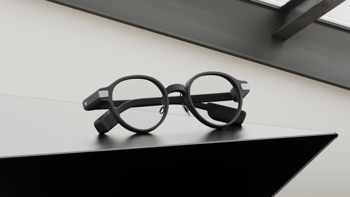
Even Realities' Even G2 smartglasses
For this article, I got to use a pair of the Even Realities Even G2 smartglasses. At Silmo 2024, Even Realities’ chief strategy officer Nikolaj Schnoor told former editor of NZ Optics Lesley Springall they didn’t want to create a gadget, they “wanted their smartglasses to be where you get your first interaction with your information”. Every person who tried them on went “wow!” With its technology, you can overlay information onto the spectacle lens as a personalised, heads-up display which appears to be two metres in front of you. It can show small messages from WhatsApp, SMS and Gmail. It has a language translation feature which, in real time, will translate conversation and show you what the other person is saying. Other features include turn-by-turn directions to navigate and it offers voice-to-text note-taking. The battery life is a solid 1.5 days’ worth. A gesture or side glance lets the wearer control the eyewear. It has been used by speakers giving presentations so they don’t need an autocue or to look down at notes. The green words projected on the lens are reminiscent of an old-school computer monitor. The glasses must have their arms folded a certain way to be charged in the case, which uses a C-type USB connector. The app was straightforward to use for all its features.
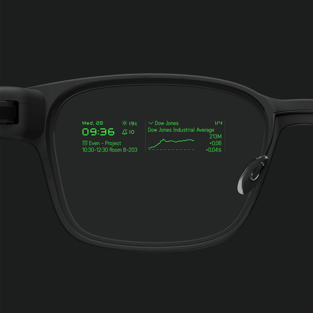
Even Realities' Even G2 wearer display
Even Realities’ G2 is different from most as it doesn’t have any cameras, thus avoiding privacy issues. This eyewear is fashionable and you can see how accomplished European eyewear designers have contributed to the final product. The eyewear has won three international Red Dot Design Awards. It comes in panto and rectangular styles and three colours. There are even clip-on sunglasses available and they will take prescription lenses. My impression is that Even Realities G2 smartglasses, which retail for NZ$1,430, is making exciting steps for the future of smartglasses. For someone who wants smartglasses without cameras, this is a very stylish option.
I was also able to try out a Ray-Ban Meta, which retails from around $570 for the Gen 1 or from $690 for the Gen 2, which has a longer battery life, better video resolution and reduced weight compared with its predecessor. First impressions were that it felt comfortable, not overly heavy and looked like a normal pair of Ray-Ban sunglasses. The case charges the frame with a C-type connector. I had to reset the glasses so I could save and view the photos and videos I took on my phone. The sound from the built-in speakers in the underside of the temples was impressive, a lot better than I expected it to be. (This is in stark contrast – and vastly superior – to the sound I’ve experienced with bone-conduction glasses.) You could still hear conversations around you when music was on and the music was only audible to others if it was really turned up. Phone calls were relatively clear and my voice was perfectly audible to the caller. It could link to Spotify, WhatsApp and Instagram and read messages from those platforms and let you reply. Volume was changed by sliding your finger along the temple, with single-, double- or triple-taps changing or stopping songs on Spotify. The IPX4 water-resistance rating also means it can handle light rain or splashes, but not submersion.
The front cameras in Ray-Ban Meta are 4mm in diameter and relatively discreet; they could be mistaken for design details on the frames. There are two ways to take a photo: the first is to press on a streamlined button on the top front of the right temple; the second is to say, “Hey Meta, take a photo”. To take a video, say “Hey Meta, take a video”. Verbalising a request to the glasses did seem weird. The photos with the 12MP camera were just OK. The video in 1080p was more than adequate, giving far better results under good lighting conditions. It was a bit existential seeing the first-person point-of-view videos I made of me looking at my hands, drinking a cup of tea and looking at my phone. A light from the camera is activated when the glasses take a photo or video, so someone can tell you are recording them.
For anyone into posting content where an overhead shot is difficult, or you are perhaps unboxing something, these glasses are a great solution. Each video can be a maximum of three minutes long. Battery life is usually around four hours, but limitations have been noted in colder temperatures, where that time plummets, leading to frustrated skiers and snowboarders not being able to record their day’s exploits. With the AI features enabled, I could easily ask and get the correct currency exchange rate and the weather forecast.
As yet, no New Zealand precise 2026 release date has been announced. Overseas, you can get Rx Ray-Ban lenses put into the frames, but I would be very hesitant to make any adjustments to the frame with a heater due to all the componentry in them. Overall, they’re a great functional pair of smartglasses that look like a pair of Ray-Ban sunglasses and a lot of people will have fun with them. Oakley’s HTSN and Vanguard smartglasses are due to hit the market soon in Australia. As these models are primarily for sportspeople, we will likely see some amazing action they capture and post.

Jeremy Wong is an optometrist at Gates Eyewear and Ocula Group’s clinical development manager.