





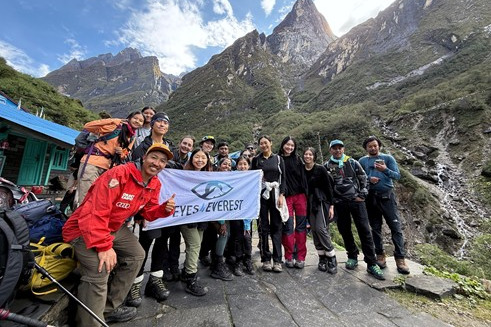
In 2025, I embarked on one of the biggest adventures of my life, trekking in Nepal’s Annapurna mountain range. The plan was to spend two weeks there, reaching the Annapurna Base Camp (ABC) at 4,130m and running eye camps along the way. I worked alongside an amazing team of optometrists led by Sherpa Kami Tenzing and Eyes4Everest founder Shaun Chang. Contributing to local communities while exploring one of my dream destinations made the experience all the more rewarding.
As a keen hiker, the Himalayas filled me with wonder and excitement. The team trekked through breathtaking landscapes in the Annapurna Conservation Area towards ABC. At lower altitudes, we were surrounded by lush green hills decorated with colourful villages and forests that reminded me of home. Among the days – which encompassed everything from sunny 30°C to dense fog, heavy rain, thunderstorms and puffer-jacket nights – one highlight was a morning in Tadapani, when we caught the sunrise. Standing on the balcony of the lodge, we had a panoramic view of the snowy peaks of Annapurna South, Machhapuchhare and Hiunchuli.
The eyecare team
My travel companions included our Eyes4Everest team of 12 and Kami’s team of guides and porters, who also supported us as translators during the eye camps. Trekking and working together all day naturally turned us from strangers to a close-knit group of friends.
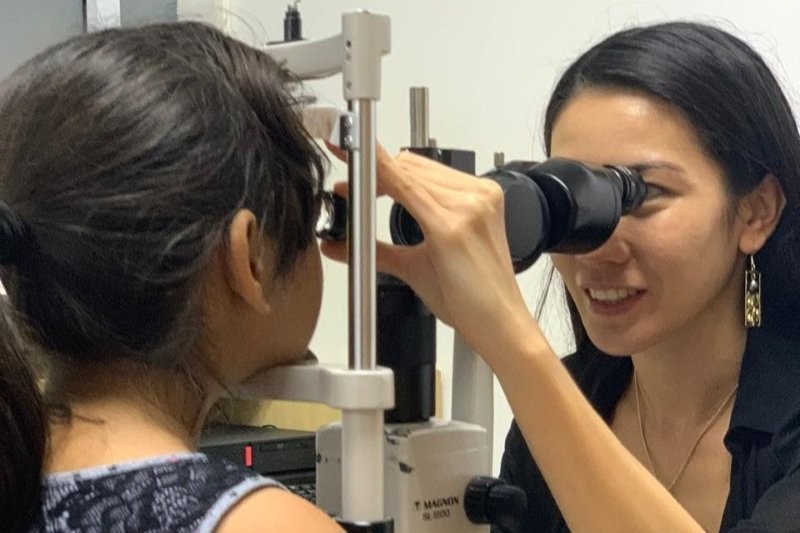
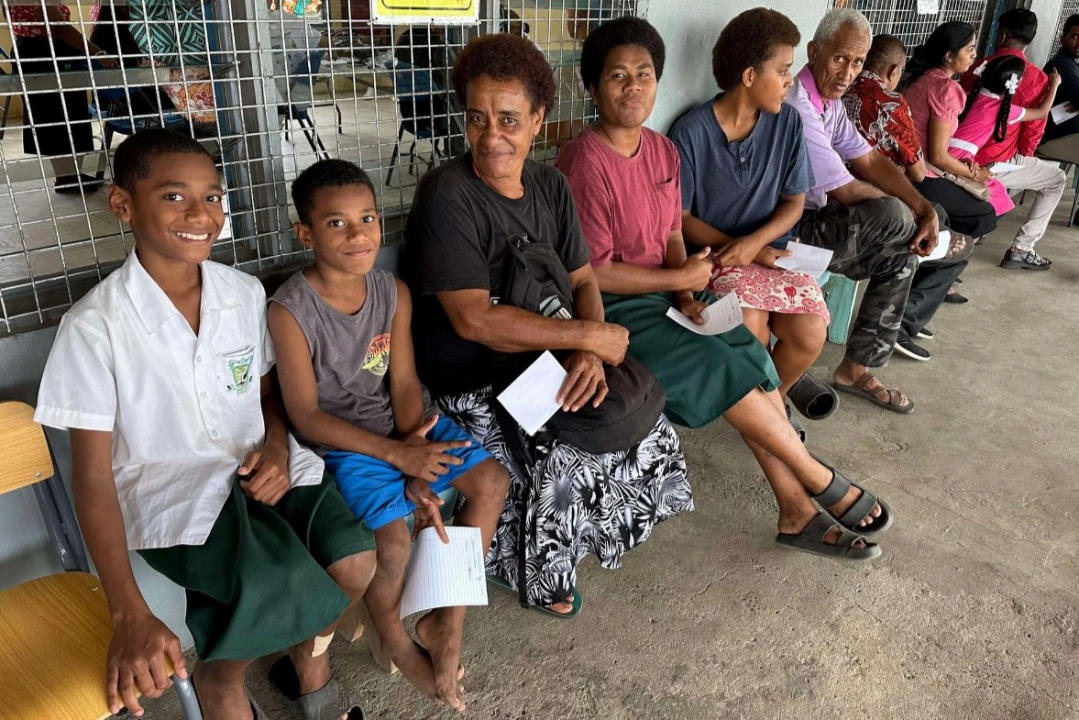
Our first eye camp took place at Ulleri Primary School, at around 2,060m. Over a full day of testing, we met local people, many of whom had walked an incredible distance to see us. The team worked at stations for history taking, entrance testing, refraction, ocular health and management. Patients who required glasses or ophthalmology care were seen at the final management station, where dispensing was carried out and referrals were made by local optometrists. Referrals were to the Himalaya Eye Hospital in Pokhara, the nearest city.
As part of the refraction team, it was impressive to see that many of the Annapurna people were emmetropic and required only a referral to the ocular health station to address their presenting concerns. My most frequent diagnosis was presbyopia and it was rewarding to see the reactions from patients who could now read easily with lenses. Yang Wang, the other optometrist on the refraction team, was able to refract a patient with high astigmatism to 6/6. The patient’s smile made her day.
One of my takeaways from the eye camp was to keep the patient’s lifestyle and visual demands in mind. I saw a 13-year-old with low myopia who reported no issues seeing the board in class and who leads an outdoor lifestyle, walking in the mountains. Back home, the typical management for myopia would have been full-time glasses with six-monthly reviews. In this case, we agreed that the benefit of glasses was not sufficient to warrant prescribing, given the lack of environmental risk factors and the patient’s disinterest in wearing them.
Many patients had moderate cataracts and dry eyes. The ocular health team organised referrals to the Himalaya Eye Hospital and provided ocular lubricants. I learned later that the Eyes4Everest team visited the hospital and the hospital director and chief optometrist agreed to provide free cataract surgeries to those who could not afford them.
At the completion of the clinic, we were thanked with beautiful flower garlands and a tika (a sacred red mark applied to the forehead) from the elders, who wished us good luck.
After we returned to the lodge, Shaun gave a binocular vision talk as a CPD event and presented a case of divergence excess exotropia he’d seen. Since vision therapy is not an option in the mountains, Shaun explored options such as spectacles with overminus lenses, yoked prisms to move the patient’s gaze away from the affected field of view and a temporal marker on the lens of the turned eye. The latter would serve as both an anti-suppression tool and a feedback device to help the patient maintain an ortho posture.
Helicopter and hospital
On our most anticipated day of climbing to ABC, I became jaundiced following what was later diagnosed as an acute liver injury. We had arrived at a rest stop in Deurali (3,200m), surrounded by beautiful mountains. Shaun coordinated with the chief guide, porters, travel insurance and the helicopter company to get me to hospital. I spent the rest of the day trekking down to the nearest helicopter pad, in Upper Sinuwa (2,340m). The slow going, with heavy rain and me becoming increasingly unwell, gave me firsthand experience of the barriers to healthcare that Annapurna locals face.
From the air, I was treated to spectacular views of the mountains and the colourful buildings of Pokhara, where I stayed in hospital for the next week. A helicopter ride had always been on my bucket list, but I never imagined this was how I’d be experiencing it!
Reflections
My time in Nepal, from Annapurna to the hospital in Pokhara, showed me there is something to be gained in every experience. The trip was fun and rewarding, but also tested me physically and mentally. During challenging times, I discovered how adaptable, resilient and independent I can be. This experience has given me the confidence to pursue future adventures and I would definitely return to the Himalayas.
Even though I didn't reach ABC this time, the fun I had on the mountain with the team reminded me that it’s about the journey, not the destination.
For anyone sitting on the fence about taking part in a similar outreach, I’d encourage you to go for it. There are likely to be detours and surprises, but I found that if you make the most of the experience, it will still be an extraordinary adventure.
Lillian Lei is an optometrist at Specsavers Whanganui and an honorary teaching fellow with the University of Auckland.