







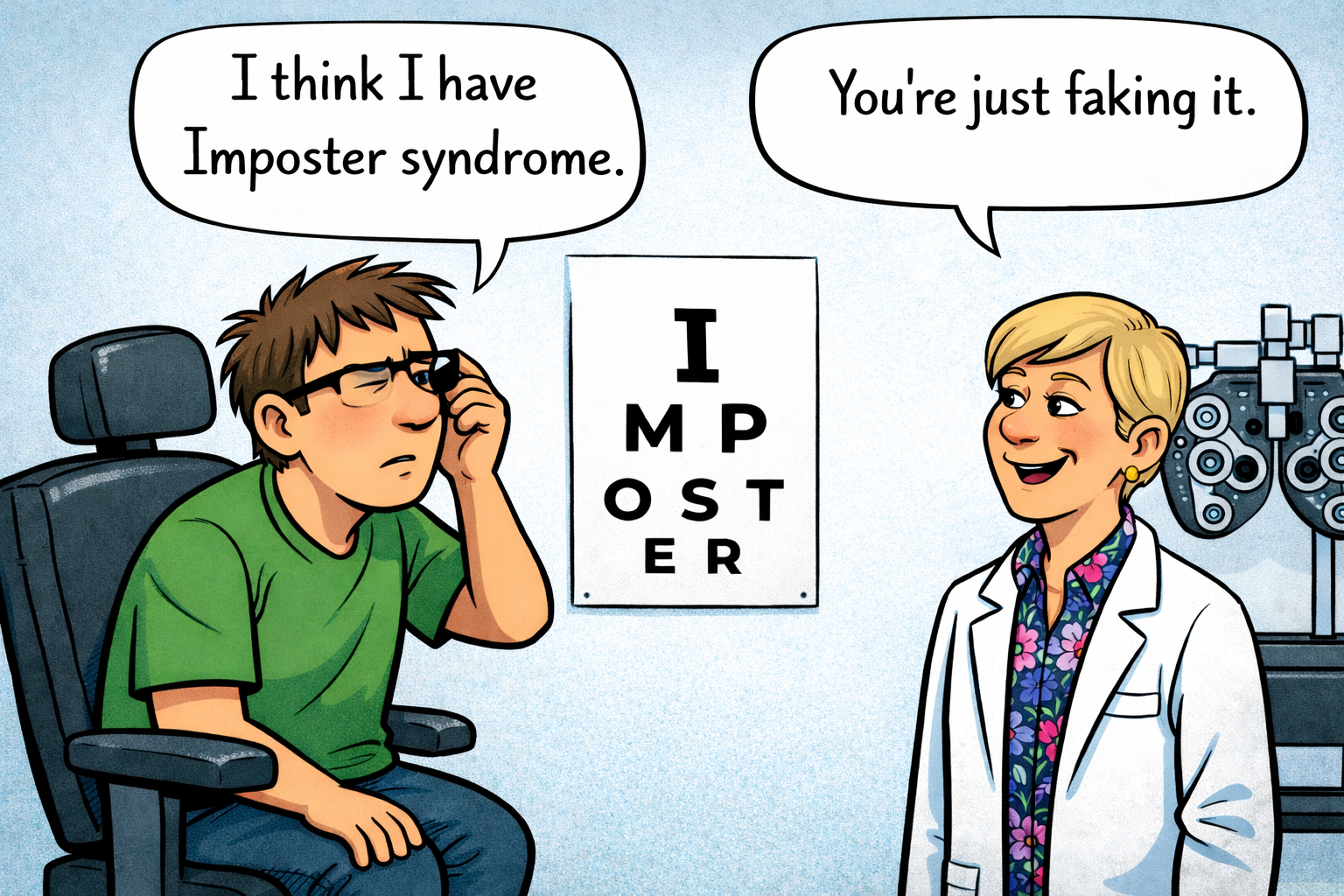
After hearing Australian ophthalmologist Dr Tanya Trinh speak about impostor syndrome at the 30th Eye Institute conference, Naomi Meltzer found herself reflecting on confidence, credibility and the quiet persistence of impostor syndrome among ophthalmic professionals. Here she unpacks what the syndrome is, who is most likely to experience it and a few tips to combat it.
There was a sudden spark of recognition when I tuned in to the end of an interview with All Blacks legend Sir John Kirwan and heard him mention his struggle with impostor syndrome (IS). I had never heard the term before but instantly knew what it meant.
IS is a psychological experience in which a person feels intellectually or professionally fraudulent. Those who experience IS often doubt their skills, talents or accomplishments. They often feel they are not as competent as others and have a persistent internalised fear of being exposed as frauds.
Though not recognised as a psychiatric disorder, IS has become widely discussed outside academic literature, especially in the context of achievement in the workplace. A 2025 study conducted by the University of Idaho concluded there is a strong positive correlation between impostor syndrome, rigid and self-critical perfectionism and low self-esteem. It tends to occur in high-achieving professionals balancing demanding careers and family life. There is a high prevalence among clinicians and academics, with as many as 22–60% of physicians thought to experience the syndrome. Sportspeople are particularly vulnerable, given their often single-minded pursuit of perfection.
The concept was coined in 1978 by US psychologists Pauline Clance and Suzanne Imes1. Their study of high-achieving women showed a pattern of:
This was in the context of more women entering male-dominated professions, often facing bias and scrutiny both in the workplace and in the home. However, more recent research shows feelings of IS affects all genders, although there’s still a higher prevalence among women.
The impostor cycle starts with a trigger such as a challenge, new role or evaluation. This brings on thoughts such as, ‘I must do this perfectly to be accepted, or not do it at all’. This leads to self-protective patterns of behaviour such as procrastination, overwork, avoidance or staying quiet. Instead of building confidence, success brings feelings that the achievement was only due to luck or extra effort and increases the fear that inadequacy will be exposed next time.
While it is normal for most people to have thoughts of inadequacy or self-doubt in some aspect of their life from time to time, IS is a low, constant rumbling of insecurity, fraudulence, or self-doubt which persists even when there is plenty of evidence to the contrary. It frequently becomes more intense after a notable achievement such as passing an important exam, earning a promotion or completing a project.
What causes impostor syndrome?
Personality traits are probably the main driver of IS. Those who experience it often struggle with self-efficacy – the belief in one’s ability to handle tasks and situations – as well as perfectionism and self-doubt. Competitive environments can also play a part. People who experience feelings of IS may have faced intense pressure from their parents over academic achievement in childhood.
First-generation achievers may feel they don’t fit in anywhere – they are out of step both at home and in their new environment. For example, being the first in the family to attend university or have a career is an achievement, but it may feel like imitating someone else unless there is someone to identify with or a mentor with similar experience to call upon.
While clinical research is limited, there is a hypothesis that trauma, particularly childhood experiences, may play a role. Critical or inconsistent parenting is thought to contribute to a core belief of never being good enough. Likewise, consistent over-praising may lead to unrealistic standards or make achievements feel fake. Trauma from adverse childhood experiences such as rejection or separation may be linked to poor emotional regulation and attachment anxiety, which can fuel impostor feelings.
According to Dr Valerie Young of the Impostor Syndrome Institute, Massachusetts, US, there are five IS personality types:
Seeing posts on social media heavily edited to show only the best pieces of someone else’s life only reinforces feelings of inadequacy. Recognising such thoughts as IS rather than facts, and being mindful that other people experience similar thoughts, can be helpful in taming them. Reframing thoughts from negative to positive, such as ‘I worked hard; I earned this’ or ‘I am still learning and that’s OK’, is also a useful tool. Recognising that you have had these thoughts before and focusing on progress rather than perfection can also be soothing.
IS isn’t just an interesting self-help topic. “It’s a bottom-line issue negatively impacting productivity, advancement, retention, innovation and health and wellbeing,” says Dr Young.
“The only way to stop feeling like an impostor is to stop thinking like an impostor.”
Resource and reference
Headspace Australia – headspace.org.au

Naomi Meltzer is an optometrist who has recently retired from running an independent practice specialising in low-vision consultancy. She is a regular contributor to NZ Optics.